
Omnichannel value
Customers using stores, home delivery, and Click & Collect spend five times more than in-store-only customers. BAU must protect the full journey, not only the website.
Product strategy / Operating model / Omnichannel retail
A research-backed product case study that turns an omnichannel retail strategy into a practical system for prioritisation, delivery, measurement, and continuous improvement.
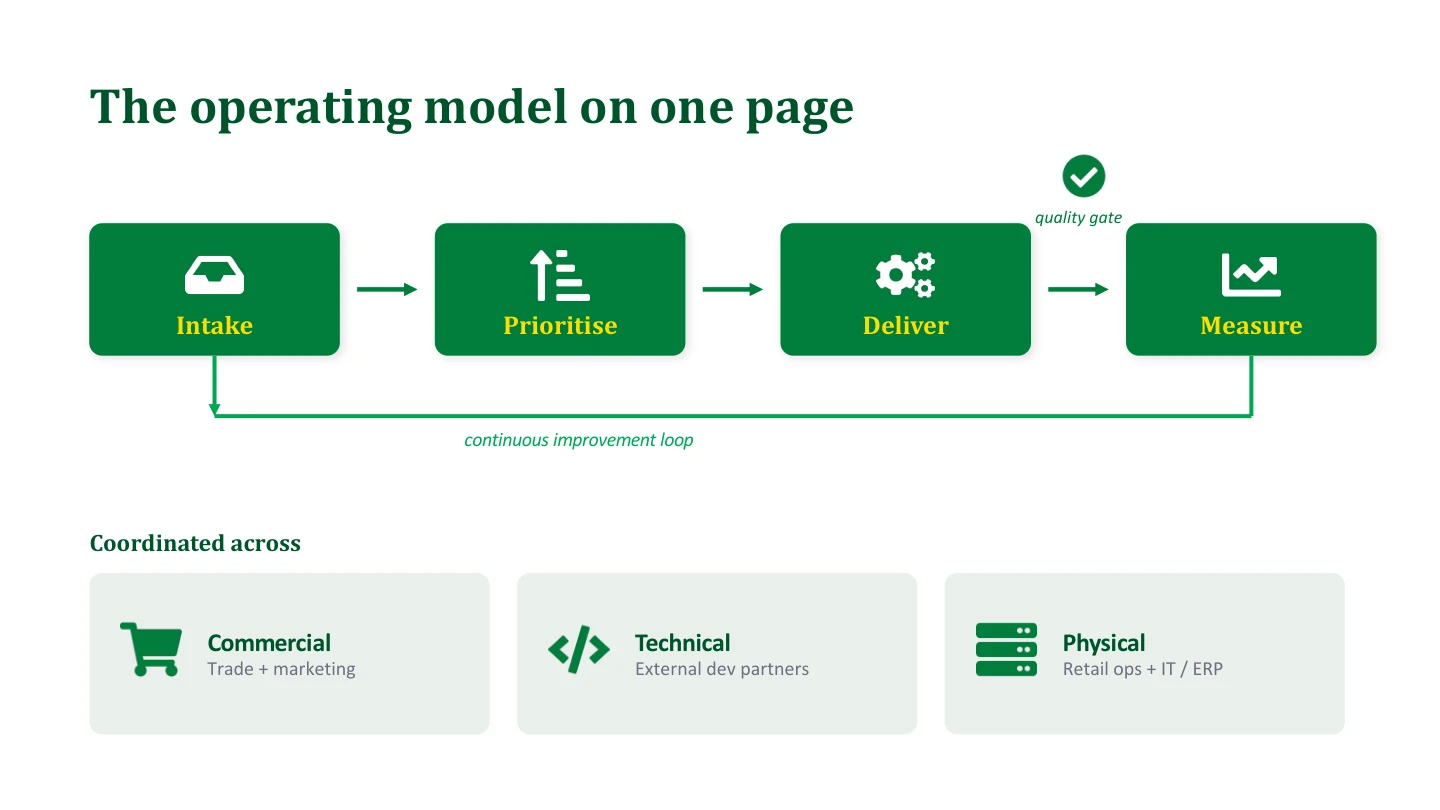
Operating-model artefact from the Woodie’s product case study, connecting intake, prioritisation, delivery, and learning.
The Woodie’s brief asked for an effective business-as-usual operating model that could support reliable day-to-day delivery and long-term strategic objectives. I treated that as a product design problem: how should work enter the system, earn priority, move safely into production, and create evidence for the next decision?
My research connected the brief to Woodie’s published digital ambition. The business was planning to triple digital’s share by 2030, grow the digital channel by 130%, and advance four growth drivers across range expansion, loyalty, retail media, and mobile commerce.
This work was created in response to a Digital Product Executive case brief. The research, prioritisation choices, operating model, measures, and implementation plan are my own.
I reviewed Woodie’s public strategy, omnichannel customer evidence, delivery context, and seasonal retail cycle. Four constraints shaped the model.
Customers using stores, home delivery, and Click & Collect spend five times more than in-store-only customers. BAU must protect the full journey, not only the website.
Garden, decorating, and Christmas peaks change the acceptable level of release risk.
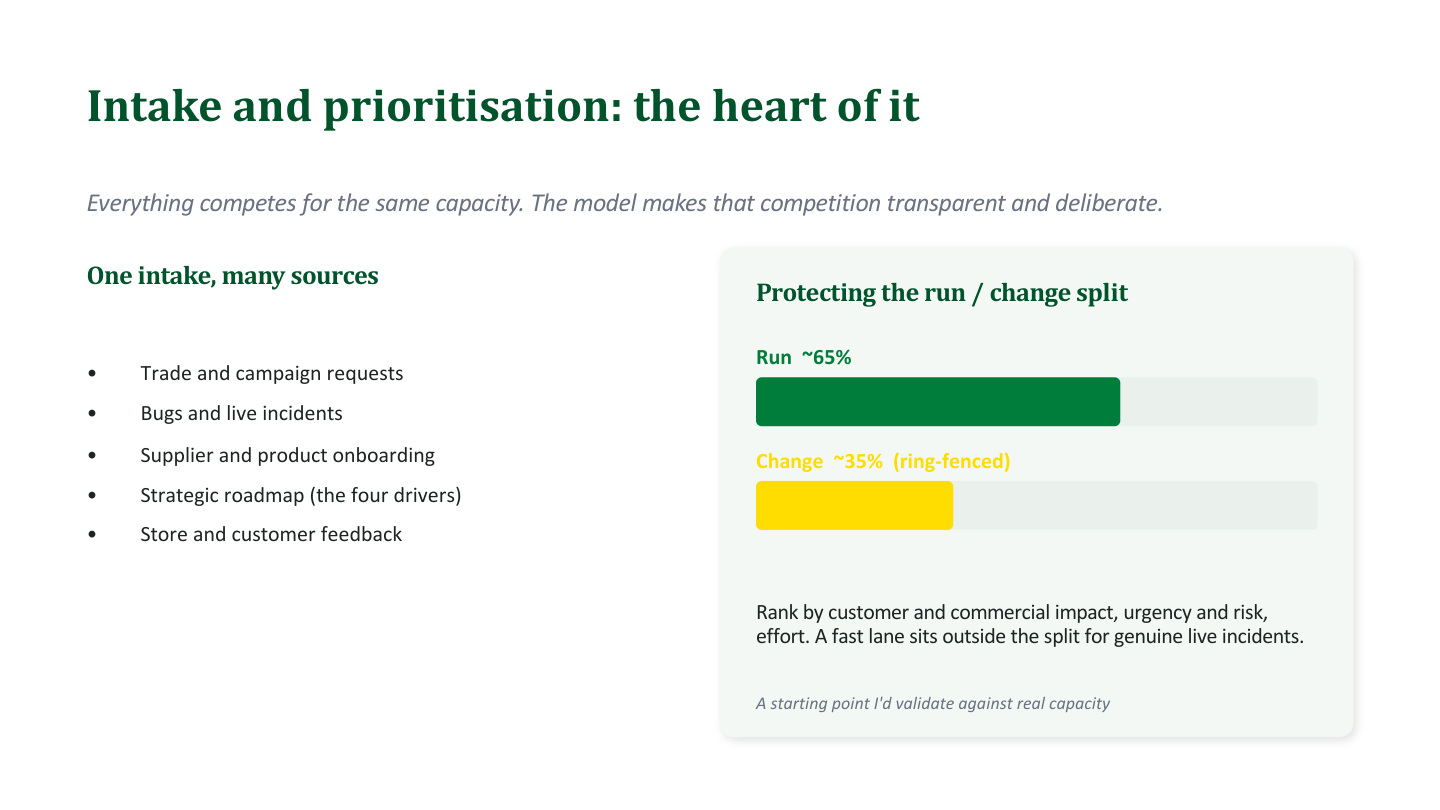
Campaigns, incidents, supplier onboarding, and strategic work compete for the same team.
Commercial, technical, and retail operations must make one coordinated product decision.
Every request enters one visible intake. Work is ranked by customer value, commercial impact, urgency and risk, then effort. A separate fast lane is reserved for genuine live incidents so that an emergency does not distort normal prioritisation.
A longer release cadence concentrates more change into each production event. I designed a light delivery engine with explicit readiness, testing, release ownership, rollback planning, and post-launch monitoring.
My quality decisions were informed by prior delivery evidence: 95% accurate document processing on Bill Reader and 97% automated test coverage at Mastercard. Those are examples from my earlier work, not Woodie’s outcomes.
See the Bill Reader evidenceThe operating model uses two layers of evidence. Operational health shows whether delivery is dependable. Strategic progress shows whether protected change capacity is moving the business toward its published ambition.
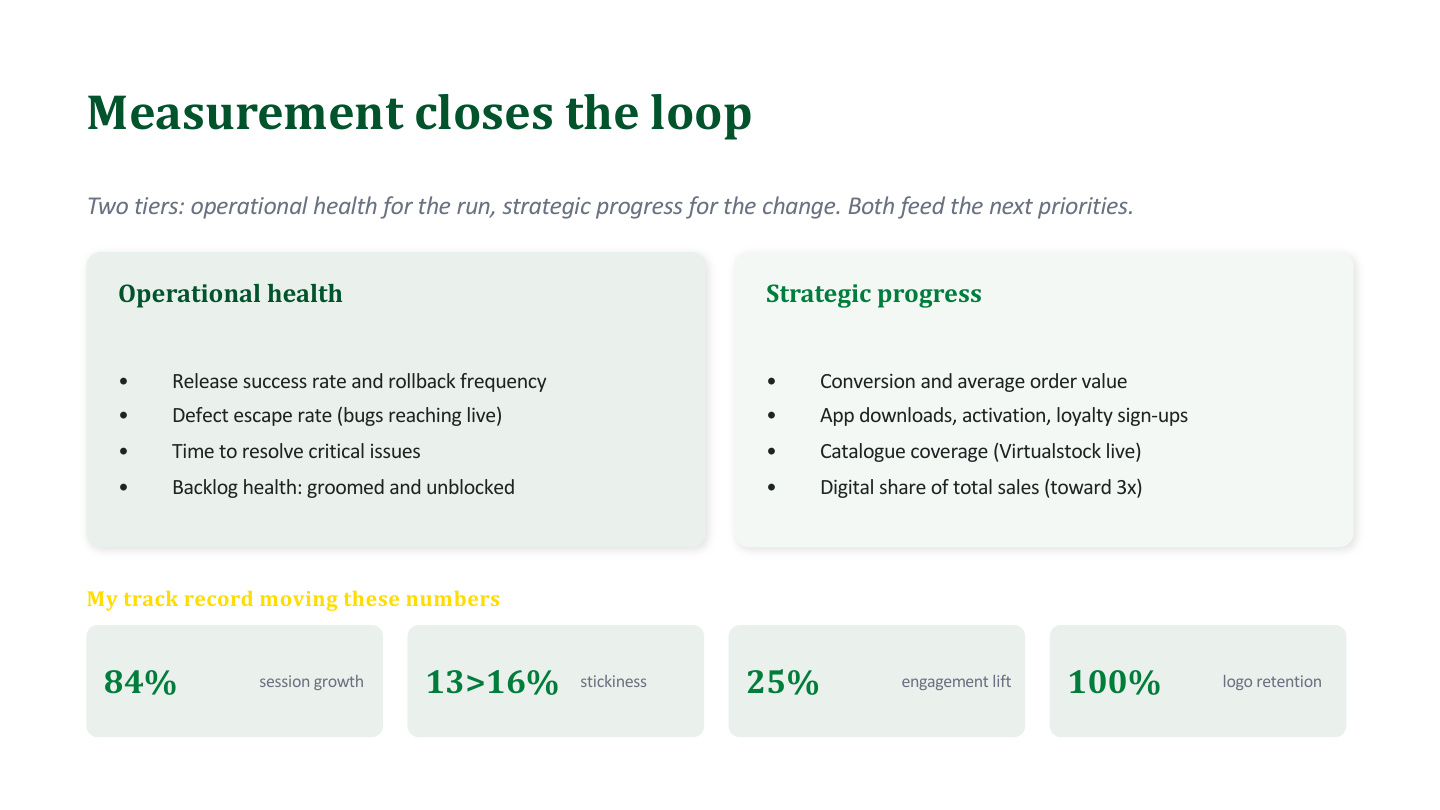
These measures define how I would evaluate the model. They are not presented as achieved results.
A useful BAU system cannot allocate capacity identically throughout the year. Release risk should tighten around major trading peaks, while quieter windows create room for strategic change and platform improvement.
Protect garden trading and schedule larger changes around peak demand.
Support decorating demand and prepare the Christmas release plan.
Use a Christmas code freeze, then reset priorities for the new year.
An app and loyalty launch enters as a 0-to-1 change initiative. Supplier onboarding becomes repeatable BAU work. Retail media depends on a performant, measurable digital estate. The model provides one decision path without pretending that every type of work is identical.
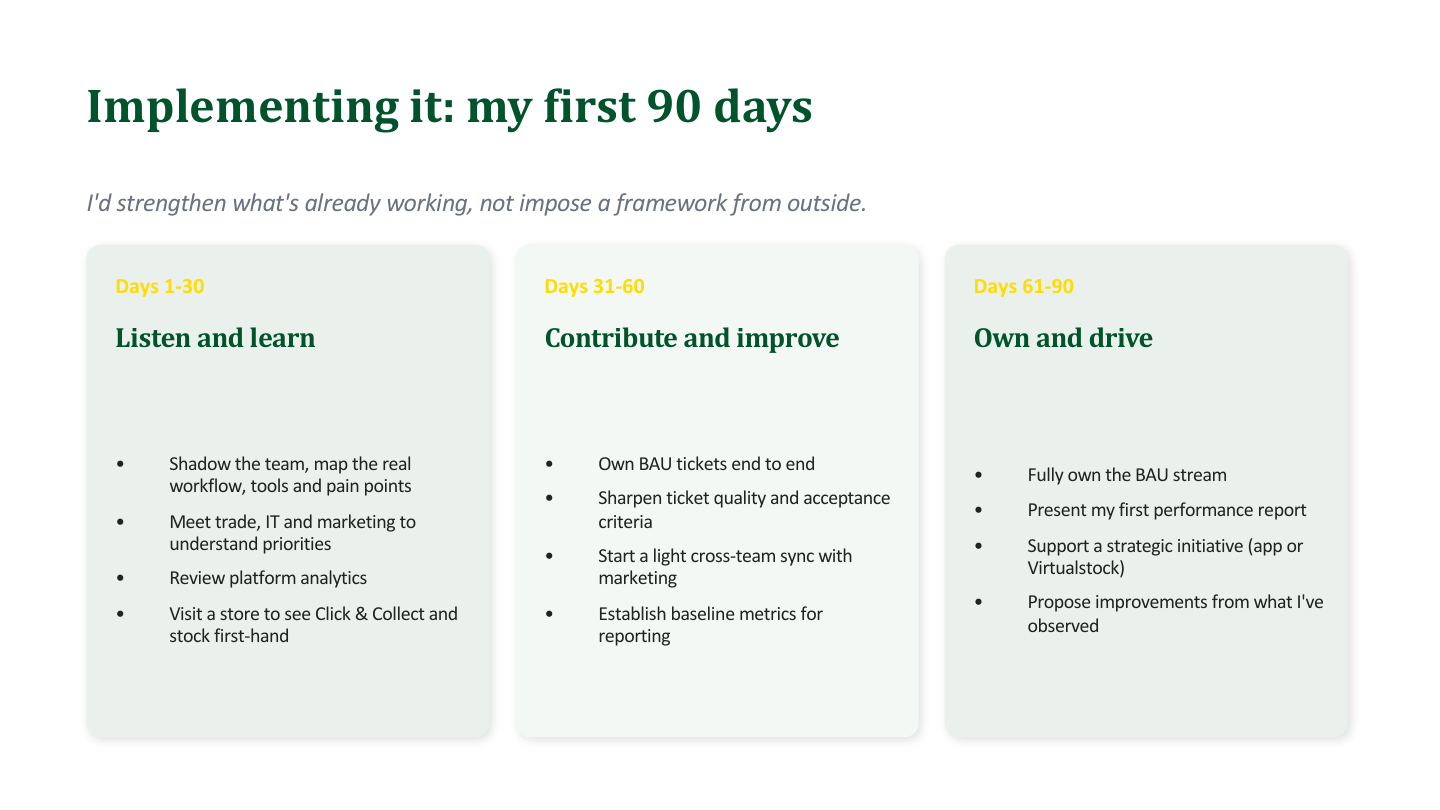
I designed the first 90 days to strengthen the existing system before changing it. The plan moves from observing real work, to improving ticket and measurement quality, to owning the BAU stream and supporting a strategic initiative.
This case study demonstrates how I research a business, identify the operating tension, turn strategy into prioritisation rules, make capacity trade-offs explicit, define success measures, and plan adoption with the people who will use the system. The result is a complete, testable operating model with clear criteria for future validation.
I would test the model against six months of real requests and incidents. That evidence would show whether the initial capacity split is realistic, where work waits longest, and which quality checks prevent the most expensive failures.
Run a four-week shadow cycle without changing the current process. Compare intake age, priority changes, blocked work, release defects, and strategic capacity against the proposed model before adopting it.
I am based in Dublin and interested in Product Manager opportunities across Ireland and the EU.