
Selected work 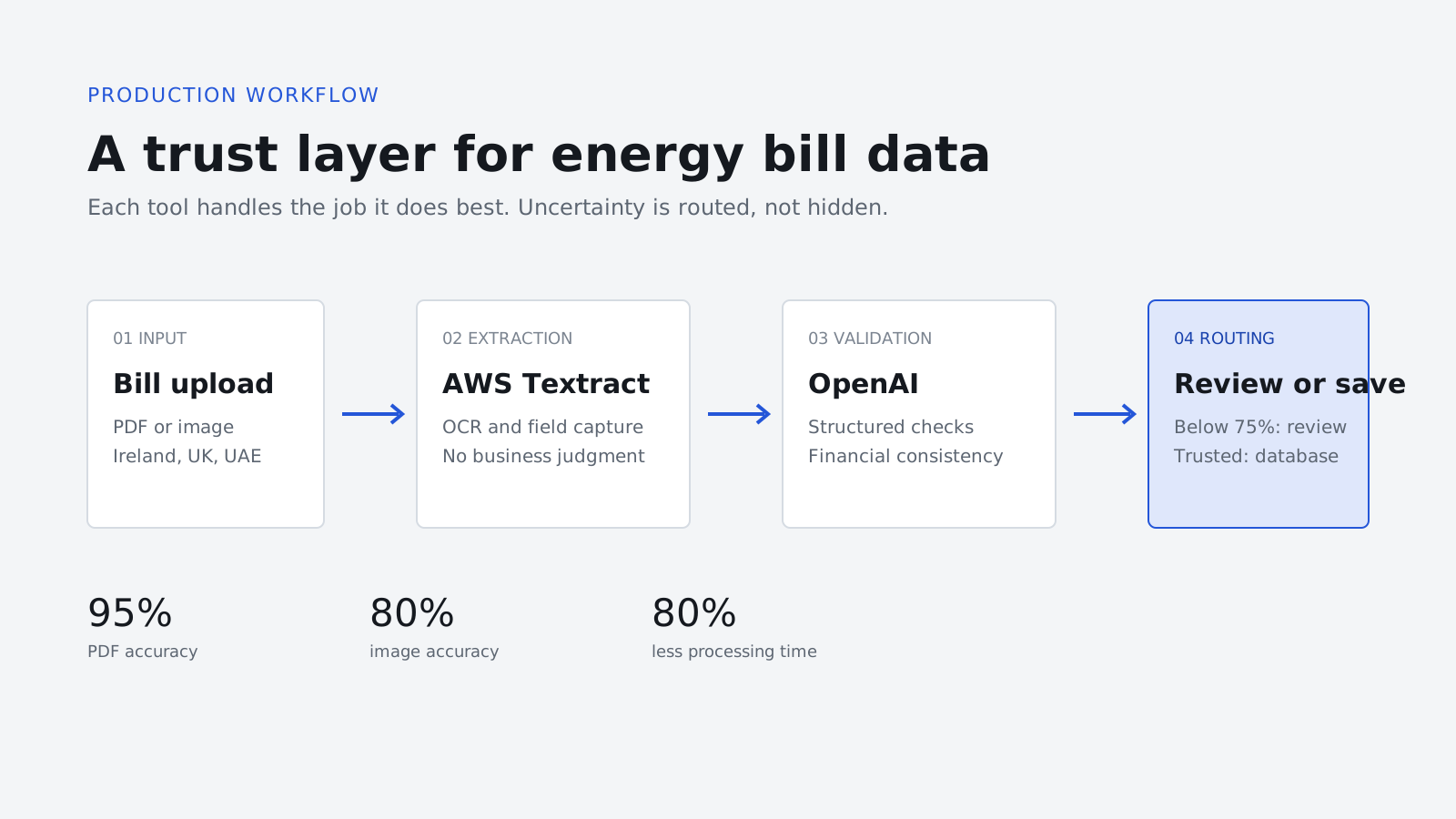
AI product / Energy SaaS / Human review
Rebuilding an energy bill pipeline people could trust
A production AI workflow that separated extraction from validation and sent uncertain results to focused human review.
- Role
- Product Owner
- Period
- July to December 2025
Product-system artefact showing the extraction, validation, and human-review decisions behind the workflow.
95% accurate document processing
80% image accuracy
80% less processing time
- Team
- Cross-functional energy team
- Product stage
- Production workflow
- Customer
- Enterprise energy teams
- My ownership
- Success criteria, evaluation, rollout
- Key constraint
- Variable formats and financial accuracy
The system extracted data quickly, but nobody trusted it.
When I joined Watt Footprint, energy bills were processed through a direct model call and written into the platform. Spot checks exposed recurring errors in account numbers, unit rates, standing charges, VAT, and totals.
The immediate cost was manual validation. Ten bills could take 60 to 90 minutes to read, cross-check, calculate, and correct. The larger cost was product trust. Incorrect financial data could slow onboarding and undermine the dashboard before customers saw its value.
The input was inconsistent by design.
The platform supported electricity, gas, and water bills across Ireland, the UK, and the UAE. Inputs ranged from clean digital PDFs to scanned images with skew, blur, missing fields, and provider-specific layouts.
I worked with operations, engineering, and data to make the technical trade-offs understandable. That included explaining why OCR accuracy and financial correctness were related but different product measures.
Three releases clarified what each technology should do.
Direct model extraction
Fast to build, but values could be invented or misread without a dependable error check.
AWS Textract extraction
Improved printed-text recognition, but brittle parsing still failed on financial edge cases.
Extraction plus structured validation
Textract extracted the document. OpenAI checked structured output and financial consistency.
Upload→Extract→Structure→Validate→Review or save
Accuracy needed a repeatable evaluation method.
Before committing to the extraction approach, the team tested a deliberate mix of clean PDFs, scanned documents, blurry images, and difficult layouts. We compared extracted fields against manually verified ground truth.
For financial fields, we also compared extracted totals with verified totals across each test batch. This caught small errors that could compound across an enterprise account.
My responsibility
- Defined accuracy and processing-time success criteria.
- Translated billing rules into requirements and acceptance criteria.
- Prioritized failure modes from production evidence.
- Aligned operations and engineering on the human-review threshold.
- Coordinated rollout across regional billing formats.
Automation changed the work, not only the duration.
Before 60 to 90 minutes
Read, type, calculate, and verify ten bills with sustained concentration.
After 12 to 18 minutes
Review flagged fields, confirm or correct the value, and save.
The result was 95% accurate document processing, 80% for image-based bills, and roughly 80% less processing time. The human role shifted from data entry and calculation to focused verification.
What I learned, and what I would change.
Test diverse inputs before production
The first migration was reactive. A structured bill set covering providers, regions, utilities, and image quality should have been part of the release gate from the start.
Use risk-weighted thresholds
A single confidence score treats every field equally. The next iteration should assign stricter thresholds to totals, VAT, and unit rates than to lower-risk descriptive fields.
Next experiment
Measure correction rates by field and document type, then route reviews using both confidence and business impact. That would reduce manual effort without weakening protection around financial data.
Open to Product Manager roles
Have a product problem worth solving?
I am based in Dublin and interested in Product Manager opportunities across Ireland and the EU.