
Candidate job
Find employers with evidence of sponsorship and decide where an application is viable.
0-to-1 product / Data product / Two-sided marketplace
A 0-to-1 product that turns fragmented government permit records and live jobs into practical decisions for candidates and employers.
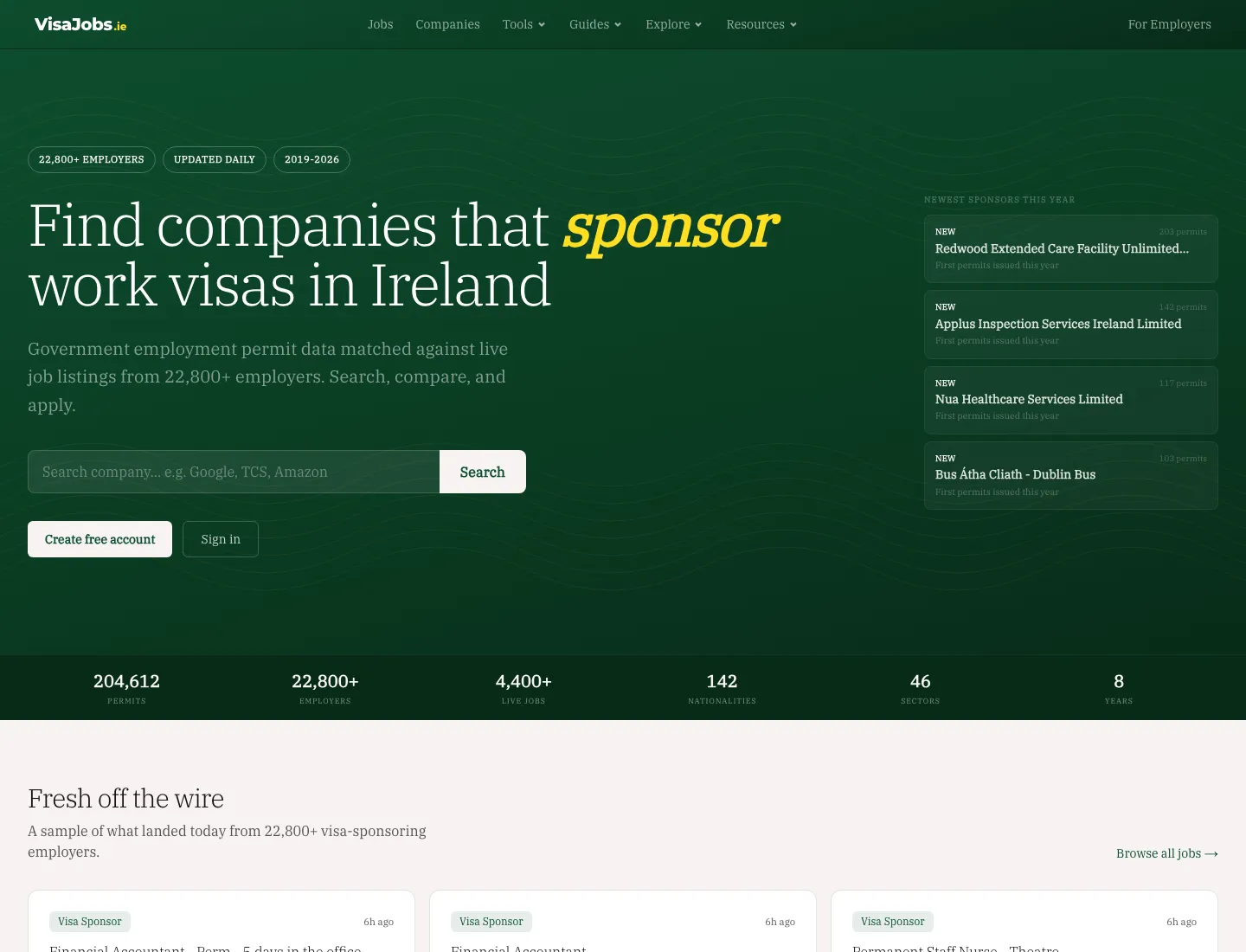
Real VisaJobs product capture showing the search experience built around public permit evidence.
While job hunting in Ireland, I kept reaching the same late-stage failure: a strong role and a promising interview process would stop when visa sponsorship came up. The information existed, but it was spread across government PDFs, spreadsheets, job boards, and company claims that were difficult to verify.
The candidate job was not simply to find more vacancies. It was to know which opportunities were worth the time before applying. The employer job was different: reach candidates who already understood their eligibility and could have a more informed sponsorship conversation.
The first product question was how to convert raw public records into a decision. A company name and permit count were useful, but candidates also needed recency, consistency, direction of travel, relevant jobs, salary eligibility, and a way to manage applications.
Find employers with evidence of sponsorship and decide where an application is viable.
Reach visa-ready candidates and prove sponsorship history without repeating manual checks.
Show the public source, verification logic, and limits behind every product conclusion.
The candidate launch produced more than candidate interest. Recruiters and employers began asking whether they could post roles directly. That signal changed the product from a candidate research tool into a two-sided system.
This protected the core promise. A sponsor label should represent evidence and a verified company relationship, not a self-reported checkbox.
As Product Manager, I framed the problem, shaped the roadmap, defined the data model, designed the core journeys, and coordinated implementation and launch. Product decisions covered candidate discovery, employer verification, job publishing, trust language, and the boundary between helpful guidance and legal advice.
I tracked public demand, product scope, search behavior, employer requests, and qualitative feedback. The next measurement layer is activation and repeat-use cohorts that connect product behavior to better-informed candidate and employer decisions.
The launch story reached 51,000+ people and generated 1,400+ click-throughs. The distribution mattered because it exposed the product to people who had already experienced the same problem.
Comments, direct messages, search behavior, and employer requests became discovery inputs. They helped prioritize comparison tools, permit explainers, salary checks, application tracking, and the separate employer workflow.
Changing product figures verified September 2026.
Starting from a personal problem made the user need clear, but the product became credible only when the evidence model was stronger than a typical job-board filter. Public provenance and transparent definitions are part of the user experience.
I would formalize activation and repeat-use cohorts earlier. Growth and public reach show demand, but the next product questions require clearer evidence about which tools change application behavior and which employer actions produce useful candidate outcomes.
Connect employer verification, candidate fit signals, and application progress into a measurable quality loop. The goal is not more listings. It is fewer wasted applications and better-informed hiring conversations.
I am based in Dublin and interested in Product Manager opportunities across Ireland and the EU.