
Selected work 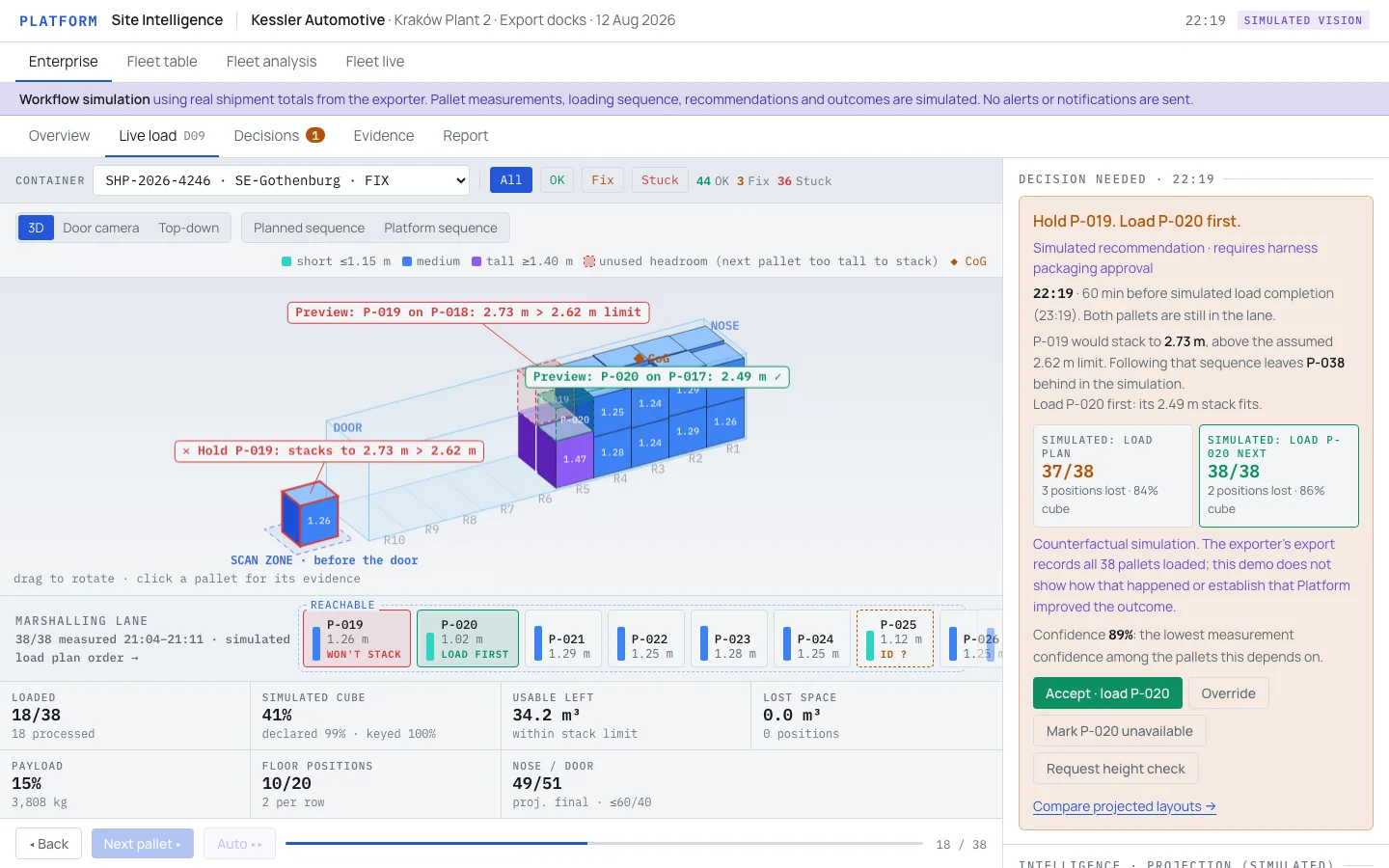
Computer vision workflow / Industrial operations / Concept prototype
Moving an under-fill alert to where someone can still act
Check pallets in the staging lane before they enter an export container, and alert the shift lead while the load can still change.
- Role
- Product Manager, self-initiated
- Period
- September – November 2026
Simulated decision moment in the Enterprise view. Shipment totals are real; pallet heights, sequence and outcome are simulated, and the prototype says so on every screen.
83 export shipments analysed
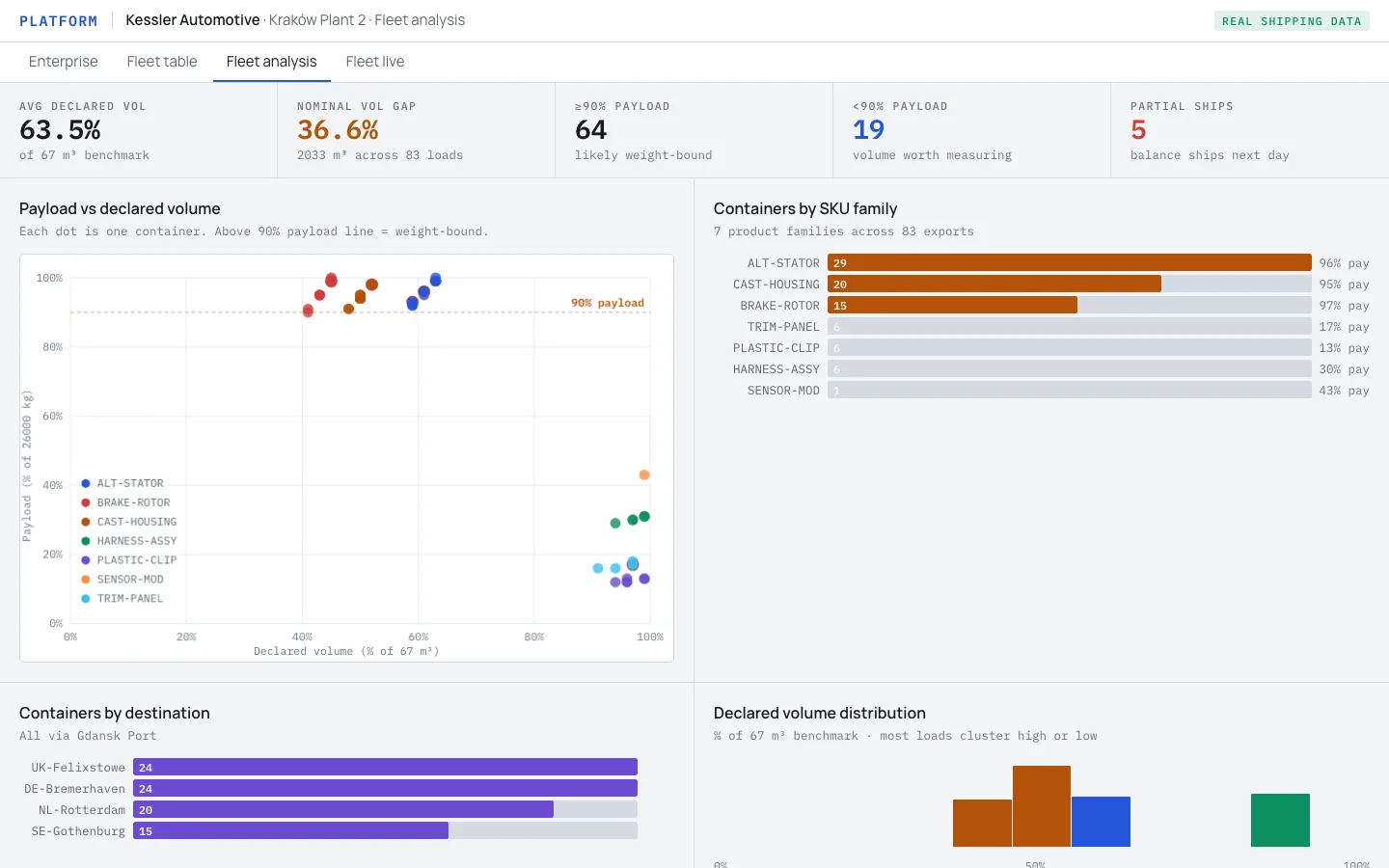
64 / 83 containers already near their weight limit
35 / 36 simulated stuck loads are parts that cannot be stacked
5 linked prototype views
- Team
- Solo, with peer and AI review
- Product stage
- Concept prototype suite
- Customer
- Shift leads and operations leaders
- My ownership
- Discovery, analysis, prototypes, engineering, pilot plan
- Key constraint
- Real totals, no pallet-level data
In short.
- The problem
- An automotive parts exporter believed its shipping containers left the plant 30% empty and asked for an alert when one was under-filled.
- The catch
- By the time a container is full, the doors are sealed and the driver leaves within minutes. An alert then changes nothing.
- What I built
- A browser prototype that checks pallets while they still wait outside the container, and tells the shift lead which pallet to load first so that everything fits.
- What I found
- In the 83 real shipments, most of the visible empty space is really a weight limit. In my simulation, most loads that do not fit cannot be fixed by reordering at all: stacking rules matter more. Pallet heights are simulated, and the prototype says so on every screen.
- Try it
- Open the Container demo below, press Watch the load, and accept or override the recommendation when it appears.
The customer asked for an alert nobody could act on.
This is a self-directed product study, built from a customer brief I was given. The customer, an automotive parts exporter, believed its containers left the plant 30% empty. The VP of Operations wanted a real-time alert when a container was going out under-filled.
The logistics manager pushed back: the doors are sealed and the driver is moving about four minutes after the last pallet goes in. My first answer agreed with him and set the alert aside, focusing instead on the shipping export.
The data could not answer the question it was asked.
The brief's three-week shipping export covered 83 containers. Weights were recorded. The declared volume was not measured: it was pallet count multiplied by one fixed figure per product family, and the brief confirmed nobody had ever measured actual cube.
Move the check to where a decision still exists.
The site's existing safety cameras already faced the staging lane, not the container interior. The brief also noted that the shipping system builds a load plan the day before, and the shift lead overrides it by pulling the next thing that fits. So the product works with that habit rather than against it.
Measure in staging→Replay load plan→Advise early→Hold at the door→Shift lead decides
After every pallet, the prototype replays the remaining load plan under a simple stacking rule and tries pulling each reachable pallet forward. It shows a known fix as an advisory straight away, and only blocks a pallet at the door when waiting one more pallet would lose the fix.
What I built.
The idea is one product. The prototype is five linked views of it, each answering a different question. They run in the browser with no install, and they share the same data, rules and wording.
- Container demo One container, one decision. Watch 38 pallets load, then accept or override the recommendation. Open ↗
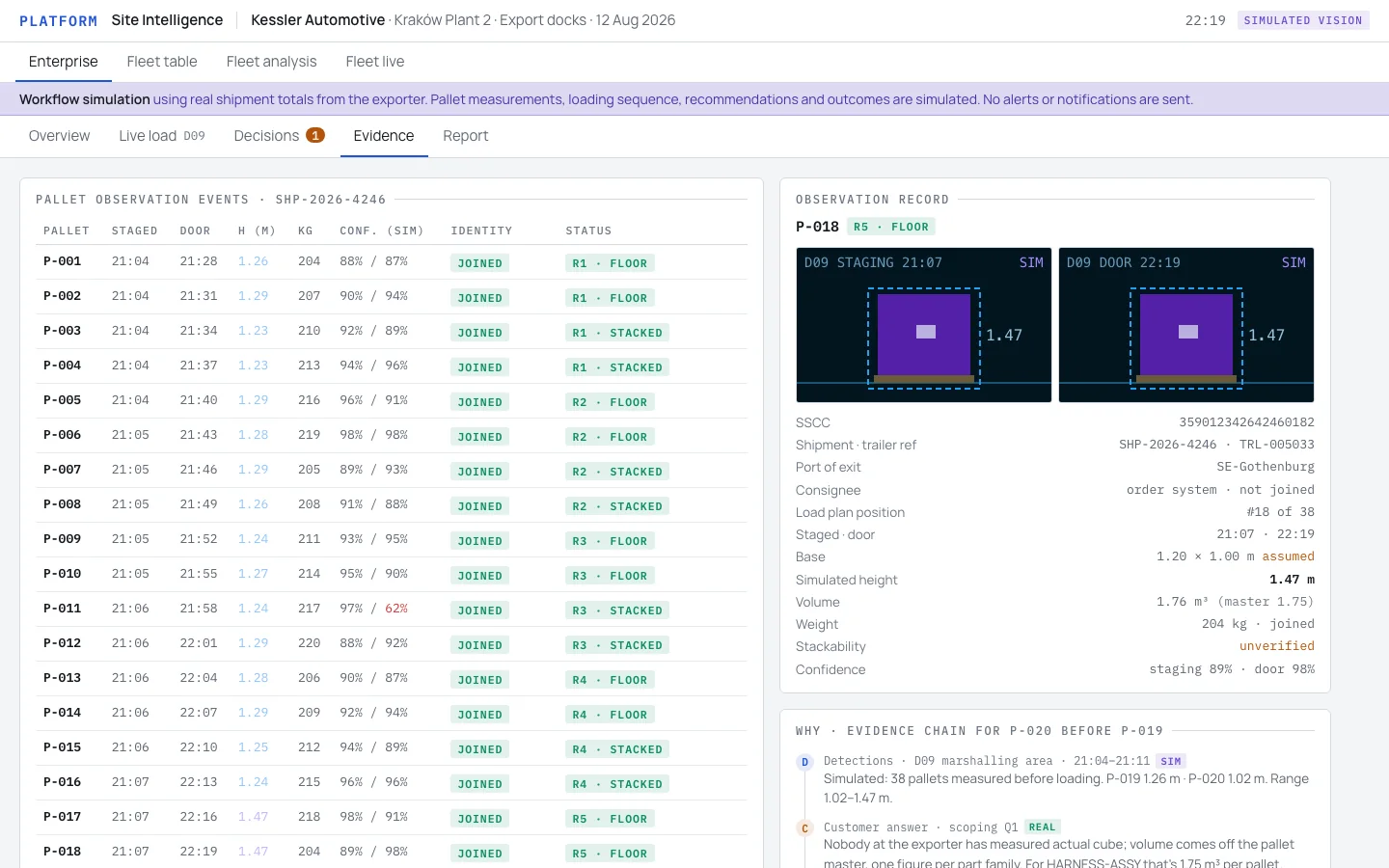
- Enterprise The site view: overview, live load for any of the 83 containers, decisions, evidence and report. Open ↗
- Fleet table Every container sequenced under the same rule. Filter by product family or outcome. Open ↗
- Fleet analysis Payload against declared volume for all 83 loads: why most visible space is weight. Open ↗
- Fleet live Pick any container and watch the loading algorithm run pallet by pallet. Open ↗
Two sequences, side by side.
A recommendation is easier to trust when you can see what it would change. Live load in the Enterprise view has a switch for exactly that. Planned sequence shows the finished container if the load plan is followed as given: 37 of 38 ship, with one pallet left at the dock and three stack positions lost. Platform sequence shows it with the one recommended swap applied: 38 of 38, two positions lost. Same loader, same pallets; only the order differs.
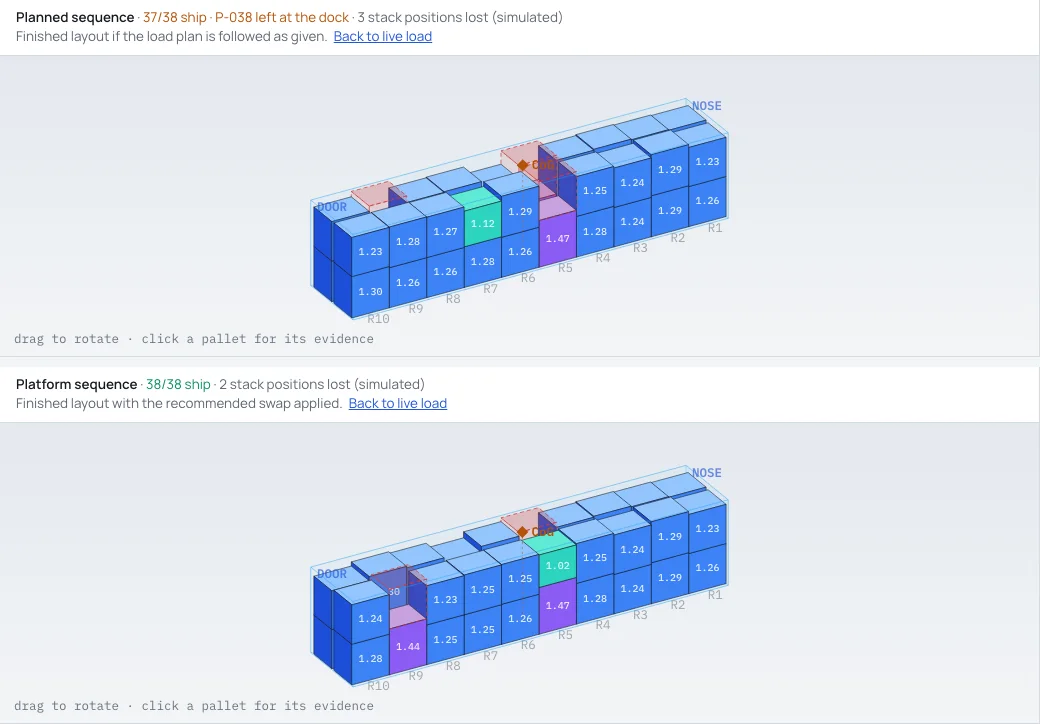
The stepping controls pause while a comparison is open, so a finished layout cannot be mistaken for progress. If the shift lead has already overridden the swap and the window has closed, the Platform view falls back to the plan instead of showing a fix nobody can make.
Designing for trust before accuracy.
A recommendation from a camera is only useful if the shift lead trusts it. The prototype treats uncertainty as part of the product, not an edge case.
From one container to 83.
One container shows the idea works. It does not show whether it generalises. So I ran every export container through the same loader and the same rule. Heights are generated per product family, so these results show how the rule behaves, not what happened on the dock.
The pattern is what mattered. 35 of the 36 stuck loads are brake rotors and cast housings, the two families the brief's scoping answers say nothing should be stacked on. For them, pallet order is not the lever; stacking permission is. The 36th is a single sensor-module load of 43 pallets.
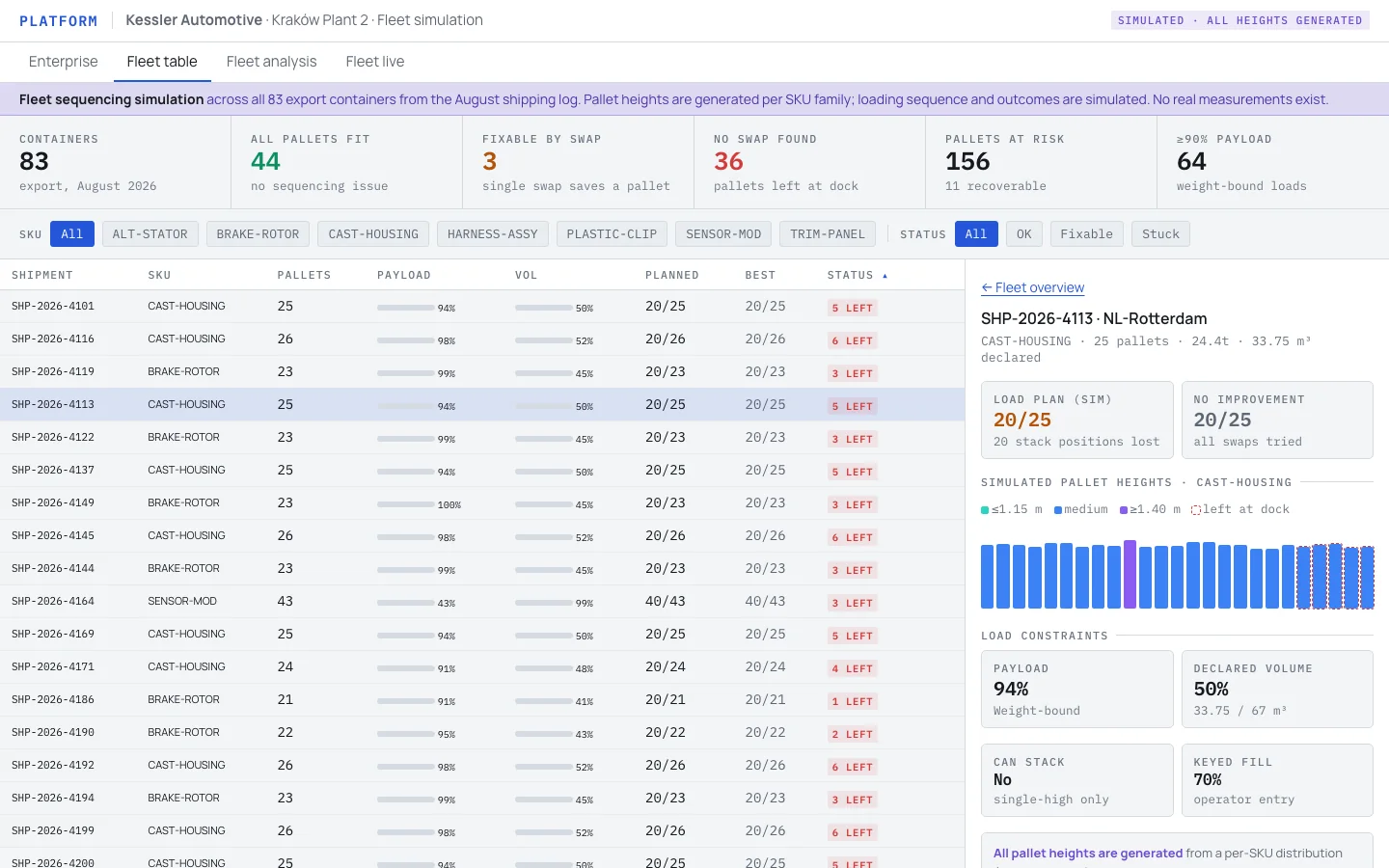
The real log shows only five of the 83 shipped partial. So either the packaging allows more than I assumed, or the loads are laid out differently from my model. Either way, the simulation turns a vague hunch about empty space into a specific question a pilot can test.
The economics, sized honestly.
Sequencing alone is small. As an illustrative scenario, if every volume-bound export rolled one pallet that sequencing could have saved (about 1/38 of a container each), that would be about nine containers and €8–10k a year. No paid container has been shown saved. It also ignores the cost of a pallet left behind: slots are booked weekly per lane, and a missed sailing can cost three days.
The case for building it is different: a screen the shift lead uses on every load leaves measured pallet heights behind, which is data the customer has never had. Container-count decisions also depend on floor positions, stacking rules and rates, so measured cube is one input, not the answer.
From pilot to operational.
Three people have to say yes, and they need different things. A product that only satisfies the one who holds the budget does not survive the dock.
Four phases, each ending in a decision
- Replay. Run real load plans through the loader and tape-measure a sample of pallets. Exit: the band where sequencing matters is large enough, and stacking rules are signed off.
- Shadow at one camera door. Read pallets in staging, log advice, show it to nobody. Exit: height error inside target, and the advice would have been right often enough.
- Live advisory at the same door. The shift lead sees the advice, and every override is logged. Exit: containers and pallets saved against the baseline, and the logistics manager agrees to expand.
- Operational. More doors (cameras cover 2 of 6 export doors today), a live load-plan feed and the shipment-to-container link. Exit: the monthly report is something the VP uses to decide.
The ask
To start, I would ask the VP for three things: a covered export door and its shift lead for the pilot loads, a week of tape measurements plus the load plans for those shipments, and packaging and driver sign-off on stacking. The first two phases ask nothing of the crew, because no advice is shown until the logistics manager has watched it in shadow mode. If height error misses its target, the pilot stops there, and the replay still leaves the customer with a measured answer about their own loads.
What I learned, and what I would change.
Interrogate the request, then return to it
I was right that an end-of-load alert had no action behind it, and wrong to stop there. The customer's request was pointing at a real need; the timing was the problem.
Label simulation as boldly as results
Early reviewers understood the idea but remembered the simulated 38-of-38 outcome as if it had happened. Banners, labels on every result and a persistent counterfactual note fixed what small disclaimers could not.
Run the idea at fleet scale
One polished container hid the most important finding. Running all 83 showed that the loads that fail are almost all one kind of product, which moved the pilot's first question from sequencing to stacking rules.
Next experiment
Measure a week of staged pallets against tape and the real load plan. That single dataset would show whether the camera is accurate enough, whether the sequencing problem occurs often enough to matter, and whether rotors and housings really are single-high.
Open to Product Manager roles
Have a product problem worth solving?
I am based in Dublin and interested in Product Manager opportunities across Ireland and the EU.